This week, Chapters 5 and 6 presented many key terms and concepts, some of which I am already familiar with and others that are completely new to me. Linear perspective is present in all surroundings in the world, it's just a matter of whether or not one choses to be aware and acknowlege it. For instance, as you drive down a long stretch of a highway, you will notice that the road will have a single vanishing point which represents a one-point linear perspective. As you will also notice, the world is full of scale. As viewers, we know that as an object gets further away from you it will appear smaller and smaller, yet we also know that this object is always going to be the same size. Perspective is apparent in daily life and choosing to acknowledge it will give you a new outlook on the world. It will help you to see things that you might have previously overlooked.
At work I am constantly looking at plot plans for houses. These are simply outlines of how the house will appear, and from these I am supposed to determine if the house will fit within the given dimensions of the lot. It's amazing that I can gather all of this from a piece of paper and some ink, while sitting at my desk. Never really having to see the actual house or lot. The concept of lines allows many things to become visually evident in the world that surrounds us. So, next time you open your eyes make sure that you are really looking at the amazing things that are right infront of you.

Tuesday, February 19, 2008

Sunday, February 3, 2008
Controversial Art
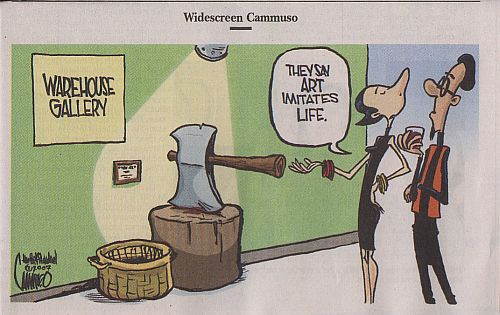
 When I think of art a variety of things come to mind. From architecture, to sculptures, to paintings, the possibilities are infinite. Now, when someone thinks of taking all of this freedom away I simply see a tragedy in the works. The freedom in which art allows an individual to express him/herself is the ultimate beauty of art. Now, as an artist, would I want to check a list of acceptable criteria before letting my imagine run wild? The answer is NO. Predetermined standards would undermine the freedom that art is based upon. Simply placing standards does not take away an individuals creativity or talent. The only thing it would do is prevent the works of art from impacting people around the world. Although, even this may be impossible. For when alcohol was banned, people found ways, right? The impact may just take longer to spread with restrictions in place and the “world of art” that we live in would be forever changed.
Artistic freedom is what makes the topic of art unique. Every country, every culture, and every individual is able to use art as a release of thoughts and ideas. Art can bridge the gaps of languages, customs, and beliefs to bring people together to view and interpret individual pieces of work. If restrictions were placed that limited such freedoms, the circulation of magnificent works of art may see a detrimental impact. Thus, limiting our connection to different parts of the world. Art goes far beyond the individual who created the work and this is what must be taken into consideration before anyone implements regulations or standards upon our connection to the world. No two people view the same image in an identical way, which allows a single work of art to inspire creative interpretations among viewers from various parts of the globe.
So, how can we leave it up to a select few to determine what is “acceptable” for the entire world? Who will these elicit few be that can bring together all these cultural ideas, beliefs and judgments to make a list of “non-controversial” art pieces? The answer is simple, really. Someone will always see controversy where they want to see it. We learn at a very young age that the world is not here to make everyone happy, it is up to the individual to find happiness. So my solution is this, if a piece of artwork has a negative impact on you, simply cross it off your list of things to see and continue on to judge the next piece. If you are not willing to interpret, or see from another’s eyes, the beauty that may be hidden in a piece of work, what are you doing in a museum in the first place? Rather than restrict everyone’s ability to take in art of all forms, simply ask yourself if you are willing to step outside your comfort zone, to enter a world of creativity, risk, imagination, and the unexpected, since this is what museums are all about. If that’s not for you, don’t go.
This week broadened my sense of the impacts of art around the world. I myself would never begin to think of restricting art. Anytime I find a piece of work I don’t care for, I just walk away, untouched and un-offended. I take into consideration that an individual put much thought and time into it and truly respect them for that. I don’t have to like it and I don’t have to look at it either. Art is truly about freewill, both from the artist’s perspective and the viewer’s. I think that is what needs to be considered. It amazes me that some people are willing to sacrifice other peoples’ freedoms, by selfishly thinking their views are above all else, and what offends them must offend all. Take a step back, you are not the only person in this world with morals, religious views, or anything else for that matter. I guess I feel the world would be a better place if everyone was willing to set aside their biases to truly appreciate the time, thought, and freedoms that go into a piece of artwork. Wouldn’t it be great if people realized, “it’s not all about you.”
 [These photos are from my trip to the Louvre in Paris. If you ever get the chance to go, it is truly magnificent.]
Sunday, January 27, 2008
Week 2 Reflections
My first two weeks in this Art Appreciation class have been extremely eye opening. Despite the hard work and time dedication that is required, I have found a new liking for the terminology that I can now use to describe my lifelong appreciation of art. I have discovered the difference between simply looking at a piece of artwork with admiration and actually taking the time to sit down and truly analyze what the artist was trying to convey through form and content. My personal favorite thus far has been the hard work and determination of Robert Smithson, that is now the Spiral Jetty. Before I read about this in the text I had no idea it even existed. Now, I am truly interested in taking a trip to view this amazing form of art through my own eyes. I find his giant earthwork to be truly inspirational, especially after digging deeper into the content of what the spiral form actually represents throughout the world.
This brings me to the topic of ethnocentric readings. I find this to be very fascinating, since it is common to impose one’s own judgment on worldly objects or ideas. Why is it that we think everyone or everything should be like “us” or think as we do? It is hard to detach yourself from biases and prejudices, although this is what is necessary to take in the true beauty or meaning behind a piece of work. After gaining the knowledge from the information I have gathered in these past couple weeks, I am now fully interested in learning to take a step back and accurately take in the true context of a piece of artwork.
This brings me to the topic of ethnocentric readings. I find this to be very fascinating, since it is common to impose one’s own judgment on worldly objects or ideas. Why is it that we think everyone or everything should be like “us” or think as we do? It is hard to detach yourself from biases and prejudices, although this is what is necessary to take in the true beauty or meaning behind a piece of work. After gaining the knowledge from the information I have gathered in these past couple weeks, I am now fully interested in learning to take a step back and accurately take in the true context of a piece of artwork.
Monday, January 21, 2008
Getting Critical About Art: Spiral Jetty
 Through his giant earthwork, Spiral Jetty, Robert Smithson helps us to see the world in a new or innovative way. He sheds light on a remote destination, which many people would not have been fortunate enough to experience otherwise. His landscape expresses much more than the photograph taken by Sandy Brooke ever could, although its remote location makes viewing it slightly difficult. His unique depiction promotes thoughtful insight into the ways in which the spiral links many cultures of the world. The location of his artwork similarly represents this idea of bringing different people together, being that it is the spot in which the first transcontinental railroad rails were joined. The contradictions (which were brought up in the text) that the spiral represents around the world are new to me. However, they are quite real and thought provoking. Smithson was a true genius, highlighting so many contradictions in a single work of art. The monstrosity of his earthwork brought the worlds attention to a small place in Utah, again connecting the different cultures’ attention to a single place.
 Smithson also touches on the idea of change. For, even though this is a man-made landscape, it has been put out to survive the weathering of nature. This spiral is at the mercy of the Great Salt Lake, America’s Dead Sea as it quickly learned after it’s completion. The Jetty was submerged by the rising water level and forced to remain hidden and isolated for over thirty years. It continually undergoes weathering and transformation, as do most object in nature. With this constant change, I can link the many different cultures of the world. For we all are forced to adapt and change in order to survive the pressures of success, change and competition. We are all at the mercy of constant reformation and adaptation, as is the Jetty.
Smithson, Chen and Bierstadt all touch on the four traditional roles of the artist, more or less. Each creates a visual image that allows viewers to imagine a world beyond their front door or their small town. It opens their eyes to the idea of infinite possibilities and a world that has yet to be discovered. They help to turn ideas and thoughts into tangible pieces of art. They all use their creativity, to courageously depict a scene that is put under the discretion and criticism of viewers from around the world.
Their works have much in common, being that they are all scenes of nature. However, there are also many differences. Smithson created a work of art in nature. His artwork is not something that formed naturally. He used his discretion to disturb nature and impose his creativity into the Great Salt Lake. He used the low water levels as his ammunition to leave his mark on the world. Although it soon fired back, proving that nature will always overpower man, submerging his hard work and creativity for over three decades. The other two artists, Chen and Bierstadt simply replicated an already existing scene in nature, intermittently imposing their own interpretations into their artwork. Bierstadt used a more traditional vision, keeping somewhat true to the colors, details and formations of The Rocky Mountains. Although one can closely depict a landscape, it is inevitable that each and every artist will reflect their personal feelings in their artwork. Chen, on the other hand, used a more simple approach, touching only on the basic formations found in his landscape of The Central Mountain. His artwork appears dull and bland, although it means much more to his Chinese culture.
Through the artwork of these three great artists I have grasped a greater understanding and appreciation of the roles art plays in our past, present and future. The ways in which art can capture an audience that can be so different and bring them to a common understanding or liking of a single piece of artwork is truly magnificent. Art has played a significant role in the world that we live in, constantly bringing different cultures together. As I learned earlier about the contradictions depicted in Smithson’s spiral formation, it is only through the true beauty of art in which a world that is vastly diverse can come together and gain a similar admiration for an individual work of art.

About Me
Hello everyone. Well, first off I’m here for my Art Appreciation class. The neatest part about art for me is the vast amount of things that fall under that category. I have loved it since I was little. My favorite form of art is architecture. I just recently traveled to London and Paris where I saw many amazing things. :) I am looking forward to learning to appreciate other forms of art too. :]
Subscribe to:
Posts (Atom)
%5B1%5D.JPG)